


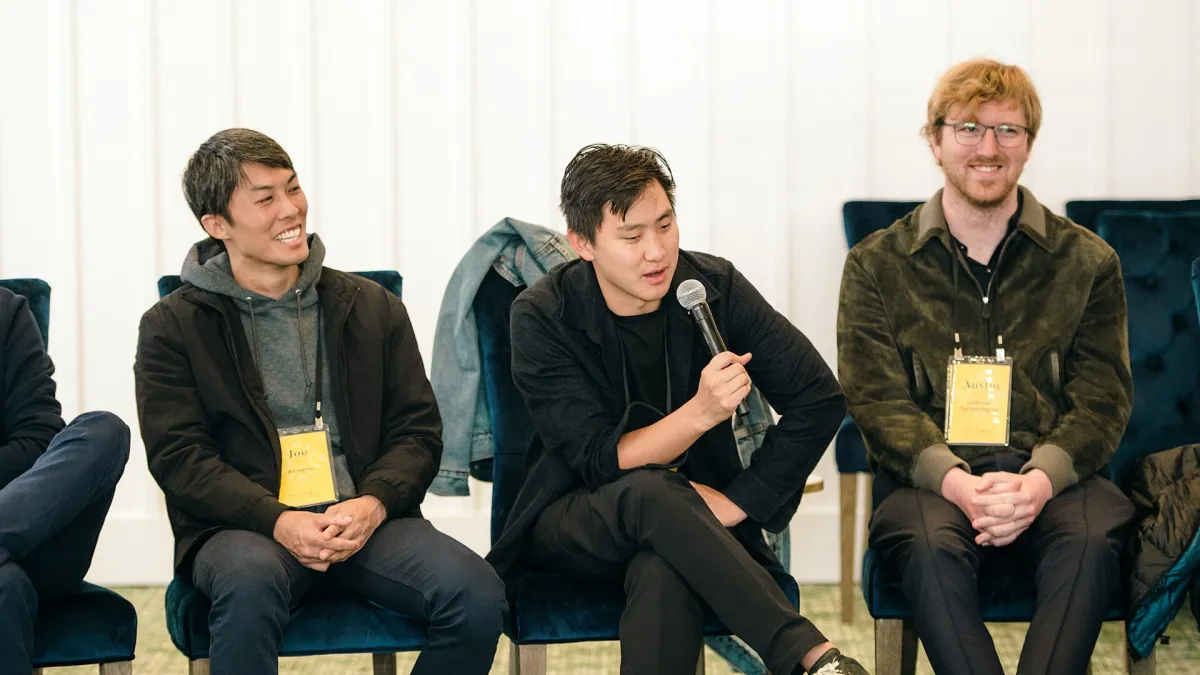
Photo: Village Global / Wikimedia Commons, CC BY 2.0, cropped
What is alexandr wang doing now: Who is Alexandr Wang and why is his AI work changing the world of mathematics
By FastBuySale Newsroom · · 1m ago · EN HI
Get breaking news & deals on your favourite app
Discover who is Alexandr Wang and how his breakthrough AI research is impacting the future of complex mathematics and global technology right here in India. Alexandr Wang leads a prominent artificial intelligence company that focuses on training advanced models to solve complex mathematical problems and logical reasoning tasks.
📌 Key points
- Alexandr Wang leads a prominent artificial intelligence company that focuses on training advanced models to solve complex mathematical problems and logical reasoning tasks.
- Recent developments in AI have allowed machines to tackle the Riemann hypothesis, a long-standing mathematical challenge that has puzzled experts for many decades.
- The integration of AI in scientific research suggests that computers will soon assist in discovering new patterns, potentially accelerating innovation across various technical sectors.
- For Indian professionals and students, these advancements highlight the growing importance of machine learning skills in navigating the evolving landscape of global technology.
Understanding the rise of Alexandr Wang in AI
What is alexandr wang doing now: The global tech community is currently buzzing about who is Alexandr Wang and how his leadership is shaping the future of artificial intelligence. As the founder of a major data-labeling and AI development firm, he has become a central figure in the race to build smarter, more capable machine learning systems. His work primarily focuses on the massive datasets required to train large language models that can reason through complex logic.
In India, the influence of such leaders is felt as local startups and tech enthusiasts adopt these advanced tools to build their own software solutions. By focusing on high-quality data and robust infrastructure, his company has set a new standard for how AI systems learn. This progress is not just limited to Silicon Valley; it is actively changing how developers and researchers across the globe approach computational problem-solving.
AI tackling the Riemann hypothesis
One of the most significant milestones recently achieved involves the application of AI to the Riemann hypothesis. This is one of the most famous unsolved problems in mathematics, dealing with the distribution of prime numbers. For years, mathematicians believed this was beyond the reach of automated systems. However, new AI models have demonstrated an unprecedented ability to verify complex proofs, proving that machines can indeed contribute to pure mathematics.
This breakthrough suggests that the barrier between human intuition and machine calculation is becoming thinner. By utilizing advanced algorithms, researchers are now able to explore mathematical spaces that were previously considered too vast or abstract. This shift is particularly exciting for the academic community in India, where there is a strong tradition of mathematics and a growing interest in integrating AI into research workflows and educational curricula.
Impact on global technology and local innovation
The implications of these AI advancements extend far beyond academic papers. As AI becomes more proficient at logic and mathematics, its ability to assist in fields like engineering, medicine, and finance grows exponentially. In India, companies are increasingly looking for ways to leverage these powerful AI models to optimize supply chains, improve medical diagnostics, and create more efficient financial algorithms that can process data at lightning speeds.
Local developers who track the work of innovators like Alexandr Wang are finding new ways to apply these concepts to real-world problems. Whether it is through automating repetitive tasks or designing better user experiences, the ripple effect of these AI breakthroughs is tangible. As these tools become more accessible, the barrier to entry for building complex, data-driven applications is dropping, fostering a new wave of innovation among Indian tech entrepreneurs.
What this means for the future of work
With AI taking on more complex cognitive tasks, the job market is set for a significant transformation. Roles that involve heavy data analysis, logical reasoning, and complex problem-solving are evolving. In India, where there is a massive pool of engineering and technical talent, this transition presents both a challenge and an opportunity. Professionals who learn to collaborate with these AI systems will likely find themselves at a distinct advantage.
The ability to guide AI, verify its outputs, and integrate its findings into business strategies is becoming a high-demand skill set. Instead of fearing replacement, forward-thinking workers are focusing on upskilling in areas like prompt engineering, AI ethics, and machine learning architecture. This shift reflects a broader trend where human creativity is augmented by computational power, leading to higher productivity and the creation of entirely new categories of jobs.
Staying ahead in the AI era
As we look toward the future, the pace of change in the AI sector shows no signs of slowing down. Leaders like Alexandr Wang continue to push the boundaries of what is possible, and the global community is watching closely. For those in India, staying informed about these developments is essential for maintaining a competitive edge. It is a time to experiment with new tools, engage with AI communities, and think critically about their applications.
The journey of AI from a niche academic interest to a foundational technology is nearly complete. By keeping an eye on the latest research and understanding the underlying principles, individuals can better prepare for the changes ahead. Whether you are a student, a professional, or a tech enthusiast, the ongoing evolution of AI offers a unique chance to be part of a historic shift in how humanity solves its most difficult challenges.
💬 Join the discussion on this article →
More in Tech · Trending News · Browse local deals
💡 What's in it for buyers
- Look for high-performance laptops or workstations on FastBuySale that can handle local AI model training.
- Explore second-hand technical books and hardware to build your own learning lab for AI experiments.
- Connect with local tech mentors on our platform to discuss the latest trends in machine learning.
- Upgrade your home office setup with reliable equipment to support your journey into data science.
FAQs
What is alexandr wang doing now?
Alexandr Wang is the founder of a prominent technology company that specializes in high-quality data labeling and AI training. His work is crucial because it provides the foundational data that allows large language models to learn, reason, and solve complex problems effectively.
Why is the AI solution to the Riemann hypothesis important?
The Riemann hypothesis is a famous, long-standing mathematical problem. AI solving it proves that machines can perform high-level logical reasoning, which was previously thought to be a strictly human capability. This opens doors for AI to assist in breakthroughs across physics, engineering, and cryptography.
How can I learn more about AI advancements like those from Alexandr Wang?
You can stay updated by following reputable tech journals, participating in online coding forums, and experimenting with open-source AI tools. Engaging with the developer community in India is also a great way to understand how these technologies are being applied locally.
Will AI change the job market for engineers in India?
Yes, AI is changing the job market by automating complex analytical tasks. While some traditional roles may evolve, new opportunities in AI maintenance, data strategy, and human-AI collaboration are emerging, making it an exciting time for skilled professionals to adapt and grow.
 KES 25,000
 KES 23,000
 KES 70,000
 KES 14,500