


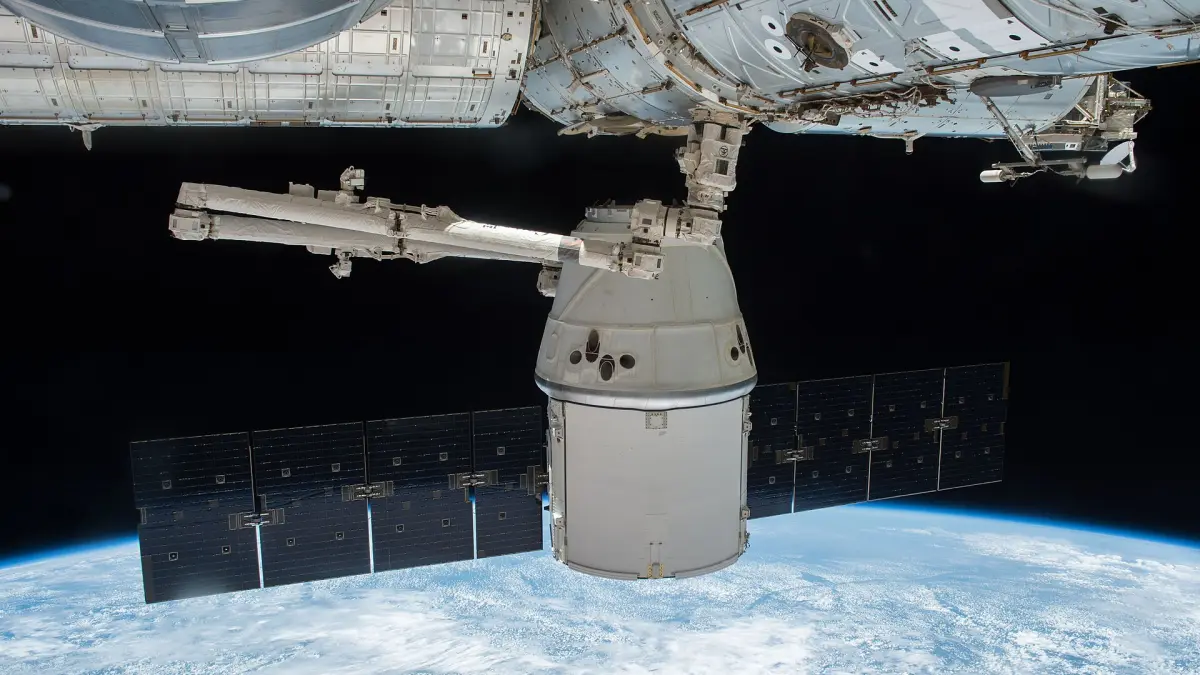
Photo: NASA / Wikimedia Commons, Public domain, cropped
What does spacex dragon look like: Understanding the SpaceX Dragon Return and What It Means for Future Space T
By FastBuySale Newsroom · · 3m ago · EN HI
Get breaking news & deals on your favourite app
Discover how the successful return of the SpaceX Dragon capsule impacts global space exploration and what is the SpaceX Dragon mission significance for India. The SpaceX Dragon spacecraft has successfully completed its latest cargo mission, returning safely to Earth after departing from the International Space Station recently.
📌 Key points
- The SpaceX Dragon spacecraft has successfully completed its latest cargo mission, returning safely to Earth after departing from the International Space Station recently.
- This reusable capsule serves as a vital link for transporting scientific equipment, research samples, and essential supplies between orbital labs and our planet.
- Engineers analyze the recovered cargo to gain insights into microgravity experiments, which contributes to advancements in materials science and pharmaceutical research globally.
- The successful splashdown demonstrates the continued reliability of automated re-entry systems, highlighting the progress of commercial space transportation in the modern era.
What is the SpaceX Dragon mission and why does it matter?
What does spacex dragon look like: The SpaceX Dragon is a sophisticated, reusable spacecraft designed to carry both cargo and crew to destinations in low Earth orbit. For those curious about what is the SpaceX Dragon mission, it represents a pivotal shift in how we handle logistics in space. By utilizing a capsule that can survive the intense heat of atmospheric re-entry, the organization ensures that valuable research conducted in space can be brought back to laboratories on the ground for further study.
In the context of global space advancements, these missions serve as a testing ground for technologies that could eventually support deeper space exploration. While the operations take place far above our heads, the data gathered during these flights helps refine engineering standards that benefit the broader aerospace sector. Understanding the mechanics of these returns provides a glimpse into a future where space travel becomes more routine, efficient, and accessible for international scientific collaboration.
The mechanics of the return journey and splashdown
Returning from the International Space Station is a complex maneuver that requires precise timing and advanced navigation. Once the Dragon capsule undocks from the station, it performs a series of departure burns to move away safely. As it approaches Earth, the spacecraft must orient itself correctly to face the atmosphere, relying on its heat shield to protect the interior from the extreme temperatures generated by the friction of air as it slows down significantly.
After shedding most of its orbital velocity, the capsule deploys a series of parachutes to further reduce its speed before making a controlled splashdown in the ocean. Recovery teams then locate the vessel, secure it, and transport the precious cargo back to shore. This entire process is highly automated, showcasing the level of technical maturity achieved by modern aerospace systems in managing the dangerous transition from space to sea.
Scientific cargo and its impact on research
The primary purpose of these missions is to transport scientific research that cannot be replicated on Earth. Experiments involving fluid dynamics, plant biology, and human physiology in microgravity conditions require a return trip to be fully analyzed. By bringing these samples back, researchers can observe how long-term exposure to space environments affects various materials, which is crucial for developing better medical treatments and more durable infrastructure for future space habitats.
For students and professionals in India interested in science, these missions highlight the importance of material science and data analysis. The findings from these cargo returns often lead to innovations that eventually find their way into commercial applications. Whether it is improving the shelf life of medicines or creating stronger alloys, the work conducted via the Dragon capsule helps push the boundaries of what is possible in modern manufacturing and development.
What does the SpaceX Dragon progress mean for local tech?
While the SpaceX Dragon operates in the vacuum of space, the growth of the global space economy creates a ripple effect that touches local tech ecosystems. As space transportation becomes more cost-effective, more organizations are encouraged to invest in satellite technology and space-based research. This trend fosters a demand for skilled engineers, data scientists, and hardware developers who can contribute to these complex international projects from anywhere in the world.
In India, the burgeoning space sector is already seeing a rise in startups that focus on satellite components and software solutions. The success of reusable spacecraft encourages a culture of innovation where efficiency and sustainability are prioritized. By observing the milestones achieved by such missions, local entrepreneurs can better understand the roadmap for space logistics, potentially leading to new partnerships and the development of homegrown technologies that align with global aerospace standards.
Looking toward the future of orbital transport
The future of orbital transport lies in increasing the frequency and reliability of these missions. As we move toward a time where space stations host more permanent researchers, the need for a consistent supply chain becomes even more critical. The ability to return cargo safely ensures that the investment in space research is protected and that the knowledge gained is not lost. This reliability is the foundation upon which future lunar and Martian missions will be built.
Staying informed about these developments is essential for anyone following the trajectory of human progress. As the frequency of these returns increases, the technology will likely become even more refined, leading to lower costs and higher accessibility. For those in the tech industry, these advancements signal a shift toward a more connected and technologically advanced future where the distinction between terrestrial and space-based operations begins to blur, opening doors for unprecedented scientific breakthroughs.
💬 Join the discussion on this article →
More in Tech · Trending News · Browse local deals
💡 What's in it for buyers
- Look for high-quality telescopes or astronomy gear on FastBuySale to track orbital objects.
- Upgrade your computing hardware on our marketplace to handle data-heavy scientific software.
- Find reliable tools and storage solutions for your own DIY engineering projects.
FAQs
What does spacex dragon look like?
The SpaceX Dragon is a cargo and crew vehicle used to resupply the International Space Station. It returns to Earth by undocking from the station, performing a deorbit burn, surviving atmospheric re-entry using a heat shield, and splashing down in the ocean with parachutes.
Why is it important to bring cargo back from space?
Bringing cargo back is essential because many scientific experiments conducted in microgravity need to be analyzed in terrestrial laboratories. This allows researchers to study the effects of space on materials, plants, and human health, leading to advancements in various fields.
How does the success of these missions affect the space industry?
The success of these missions proves that reusable spacecraft are a viable and cost-effective solution for space logistics. This encourages further investment in space exploration, fosters innovation in aerospace engineering, and helps build a sustainable infrastructure for future orbital and deep-space missions.
Can individuals participate in space research?
While direct participation in orbital missions is limited to professional astronauts and specialized researchers, individuals can contribute by pursuing education in STEM fields, working with space-tech startups, or engaging with public-facing data and scientific reports published by space agencies.
 KES 25,000
 KES 23,000
 KES 70,000
 KES 14,500