


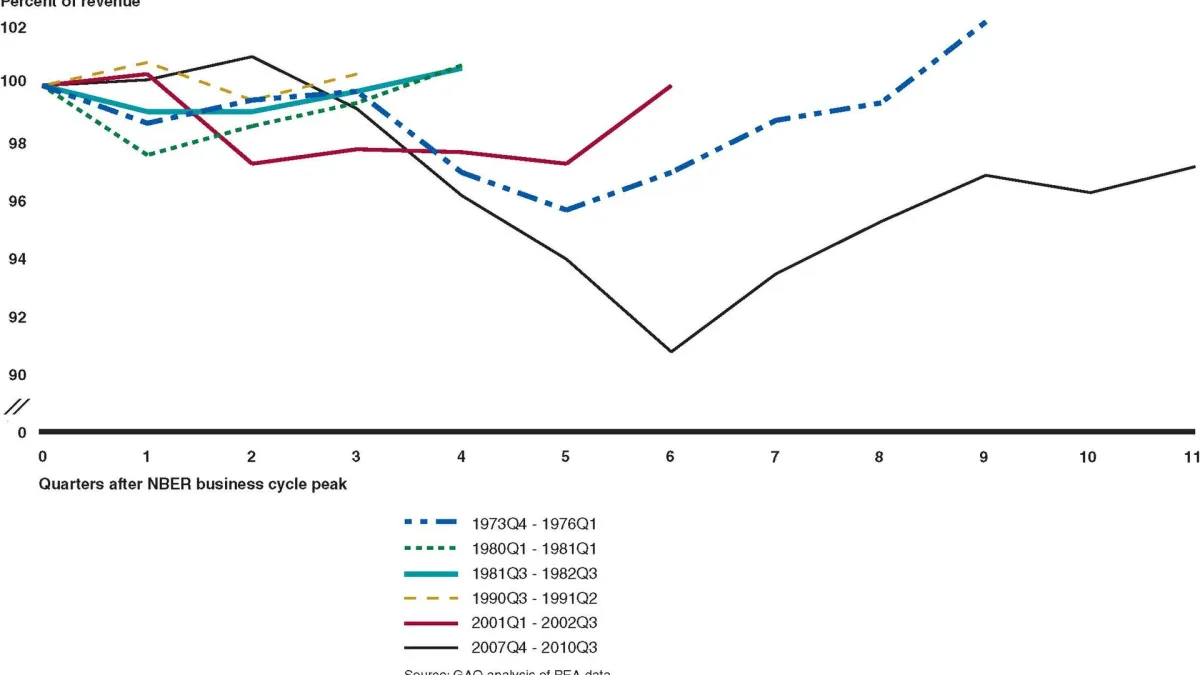
Photo: U.S. Government Accountability Office from Washington, DC, United Stat / Wikimedia Commons, Public domain, cropped
What is a recession in the US, and how is one officially dated?
By FastBuySale Newsroom · · 17m ago
Get breaking news & deals on your favourite app
Recessions in the US are dated by the NBER's Business Cycle Dating Committee, which defines a recession as a significant decline in economic activity spread across the economy and lasting more than a few months. This fir. The NBER's Business Cycle Dating Committee maintains the US business cycle chronology.
📌 Key points
- The NBER's Business Cycle Dating Committee maintains the US business cycle chronology.
- Recession = significant decline in activity, spread across the economy, lasting more than a few months.
- Most recent peak: February 2020; most recent trough: April 2020 (NBER).
- Most-weighted indicators: real personal income less transfers and nonfarm payroll employment.
- FDIC insures deposits to at least $250,000 per depositor, per ownership category, per bank.
How the NBER defines a recession
Recessions in the US are not declared by a single government statistic. The short answer: the National Bureau of Economic Research (NBER) maintains the official chronology of US business cycles through its Business Cycle Dating Committee, and its definition emphasizes that a recession involves a significant decline in economic activity that is spread across the economy and lasts more than a few months.
The NBER's chronology identifies the months of peaks and troughs of economic activity. Expansions are the periods between a trough and a peak, and recessions are the periods between a peak and a trough. According to the NBER, the most recent peak occurred in February 2020 and the most recent trough occurred in April 2020, so the most recent US recession was very short but very deep.
The NBER's Business Cycle Dating Committee says a recession is a significant decline in economic activity that is spread across the economy and lasts more than a few months. In its interpretation, the three criteria of depth, diffusion and duration are treated as somewhat interchangeable: each needs to be met to some degree, but extreme conditions on one criterion may partially offset weaker indications from another.
The February 2020 peak is the NBER's own example. The committee concluded that the drop in activity that followed had been so great and so widely diffused throughout the economy that, even if it proved to be quite brief, the downturn should be classified as a recession. The trough came in April 2020, only two months later.
Because a recession must influence the economy broadly and not be confined to one sector, the committee emphasizes economy-wide measures of activity. A slump in one industry, however painful for the people in it, isn't by itself a national recession under this definition.
By convention, the NBER classifies the peak month as the last month of the expansion and the trough month as the last month of the recession. It also notes that expansion is the normal state of the economy and that most recessions are brief, although the time it takes for the economy to return to its previous peak level of activity or trend path may be quite extended.
Readers evaluating Recessions in the US should separate marketing claims from the actual rule text that governs their account or product. When two summaries disagree, the governing document or statute wins. If a rule depends on your age, filing status, or income band, re-check it when any of those facts change. Life events quietly move people across thresholds they last reviewed years earlier.
Which indicators decide the dates
The committee bases its monthly peak and trough dates on a range of measures of aggregate real economic activity published by the federal statistical agencies. The NBER lists real personal income less transfers, nonfarm payroll employment, employment as measured by the household survey, real personal consumption expenditures, manufacturing and trade sales adjusted for price changes, and industrial production.
There is no fixed rule about which measures contribute information or how they are weighted. In recent decades, the NBER says, the two measures it has put the most weight on are real personal income less transfers and nonfarm payroll employment.
The committee also makes a separate determination of the calendar quarter of a peak or trough. Two measures that matter for quarterly dating but aren't available monthly are the expenditure-side and income-side estimates of real output: gross domestic product (GDP) and gross domestic income (GDI). The committee also considers quarterly averages of the monthly indicators, particularly payroll employment.
This is why headline debates about whether the economy is 'in a recession' can run for months. The committee's approach is retrospective: it waits until sufficient data are available to avoid the need for major revisions to the chronology, so official announcements often come long after the turning point itself.
A useful habit is to write down your goal, time horizon, and cash buffer before you change any election related to Recessions in the US. Decisions made during a stressful week are the ones people reverse later at a cost. Educational explainers like this one cannot replace personalized advice for complex situations such as divorce orders, inherited accounts, or cross-border tax residency. Escalate those cases to a qualified professional.
What a recession can mean for your money
Recessions are defined by broad declines in income, employment, spending and production, so the household effects tend to show up in the same places: job security, hours and pay, and the value of investments. Thinking through those areas ahead of time is more useful than trying to predict when the next downturn will be dated.
Your bank deposits have strong protection. The FDIC says it insures deposits to at least $250,000 per depositor, per ownership category, at each FDIC-insured bank, and that since it was founded in 1933, no depositor has lost a penny of FDIC-insured funds. Keeping your emergency savings in insured accounts within those limits means a downturn doesn't put that cash at risk from a bank failure.
Debt deserves a look too. If income could fall, high-interest balances become harder to carry. Our shows how long a balance takes to clear at different payment levels, and the helps compare the true cost of borrowing options.
For long-term investors, the NBER's observation that expansion is the normal state of the economy and most recessions are brief is worth remembering, even though recovery to the previous peak can take longer. Decisions about investments depend on your own timeline and risk tolerance, so consider professional advice for your situation.
Keep digital and paper copies of confirmations after every change. Screenshots of election pages, email receipts, and year-end statements make tax season and job changes far less chaotic. Compare fees the same way you would compare two similar listings before you buy: look at what you pay each year, what you get, and whether a simpler option meets the same need.
Key terms to know
Business cycle: the alternation between expansions and recessions in economic activity. Peak: the month activity tops out, classified by the NBER as the last month of the expansion. Trough: the low point, classified as the last month of the recession. Expansion: the period between a trough and a peak.
Depth, diffusion and duration: the NBER's three criteria for how large, how widespread and how long-lasting a decline is. Real personal income less transfers: household income adjusted for inflation, excluding government transfer payments. Nonfarm payroll employment: the count of jobs on employer payrolls outside farming.
GDP and GDI: the expenditure-side and income-side estimates of real output, used in quarterly dating. Business Cycle Dating Committee: the NBER group that maintains the official chronology of US business cycles. FDIC insurance: federal deposit protection of at least $250,000 per depositor, per ownership category, at each insured bank.
Practical steps for first-timers
Build or top up an emergency fund in an FDIC-insured account, keeping balances within the coverage limits for each ownership category. Our can show how regular deposits add up over time.
Review your budget and fixed costs, and list which expenses you could cut quickly if your income dropped. Pay down high-interest debt where you can, and avoid taking on new borrowing you would struggle to repay if hours or pay were reduced.
Keep long-term plans in perspective. The NBER says most recessions are brief, and its dates are set retrospectively, so trying to time markets around an official announcement is difficult. Follow reliable data releases from federal statistical agencies, check the NBER's chronology for official dates, and treat this guide as general information, not personal advice.
Found this Recessions in the US explainer useful? Share it with a friend, tell us what we missed in the comments, and get the FastBuySale app on Google Play () for more guides. Have something to sell? Post a free listing at in a couple of minutes.
💬 Join the discussion on this article →
More in Finance · Trending News · Browse local deals
💡 What's in it for buyers
- Keep an emergency fund in insured accounts.
- Review your budget and fixed costs.
- Pay down high-interest debt.
- Avoid trying to time official announcements.
- General information only, not financial advice.
FAQs
Who decides when a US recession starts?
The NBER's Business Cycle Dating Committee, which dates the peaks and troughs of US economic activity.
What is the official definition of a recession?
A significant decline in economic activity spread across the economy and lasting more than a few months, per the NBER.
When was the last US recession?
According to the NBER, it ran from a peak in February 2020 to a trough in April 2020.
Is GDP the only measure used?
No. The NBER uses several monthly indicators and uses GDP and GDI mainly for quarterly dating.
Why are recessions announced so late?
The committee works retrospectively and waits for enough data to avoid major revisions.
Is my bank money safe in a recession?
The FDIC insures deposits to at least $250,000 per depositor, per ownership category, at each insured bank.
 $200
 $300
 $3
 $200